
Stonehaven derailment deaths could have been avoided if drain had been built properly, sheriff finds
A Fatal Accident Inquiry into the Carmont crash, which killed driver Brett McCullough, conductor Donald Dinnie and passenger Christopher Stuchbury in 2020, has published its findings.
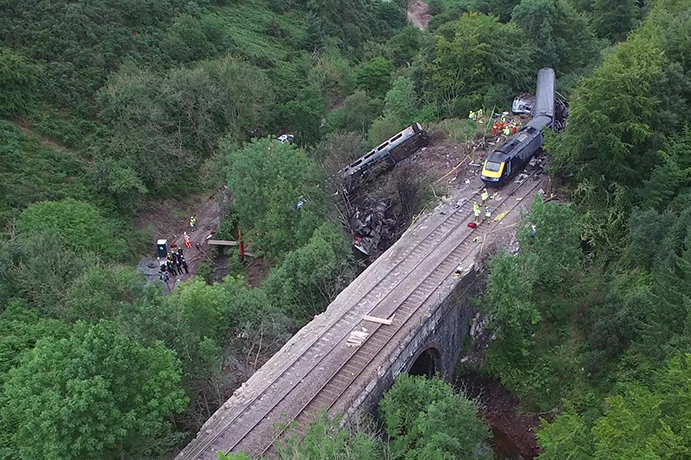
The scene of the Carmont derailment near Stonehaven in August 2020. Image from the Rail Accident Investigation Branch report. · Photograph: Rail Accident Investigation Branch (OGL v3)
The deaths of three people in the Stonehaven train derailment could have been avoided if a drain had been built and installed properly, a sheriff has found.
Train driver Brett McCullough, conductor Donald Dinnie and passenger Christopher Stuchbury died when the 6.38am service from Aberdeen to Glasgow derailed at Carmont, near Stonehaven, on August 12, 2020.
The train came off the line after hitting debris washed from a drain following torrential rain. Six passengers and three railway employees – one of whom was travelling as a passenger – were on board. Mr Stuchbury, Mr Dinnie and Mr McCullough suffered multiple non-survivable blunt force injuries, and the six other people on board were injured.
The drain that was not built to design
The Fatal Accident Inquiry (FAI) heard that the derailment was caused by the train striking debris washed onto the track from a drain after a period of very heavy rain.
Carillion Construction Limited had been instructed by Network Rail to build the new drain, with the design prepared by Ove Arup and Partners. However, the inquiry found the drain was not constructed and installed in accordance with the design and, as a result, could not cope with the flow of surface water during intense rainfall.
Network Rail was unaware that the drain had not been built as designed and did not take action to correct it.
Sheriff Johnston found that if Carillion had built the drain in line with the design, and had not built a bund at the site that formed no part of the design, the derailment could have been avoided.
It was also found that Carillion failed to prepare "as built" drawings of the new drain.
Failings by Network Rail
The sheriff found Network Rail failed to comply with its own standards in place when the drain was completed in 2012, which required Carillion to provide it with as-built details of the work. Sheriff Johnston also made findings about Network Rail's failure to ensure the drain was built properly and in line with the design drawings.
The inquiry also found that between March 2013 and the accident, Network Rail carried out no routine inspection of that section of drainage.
Weather and control room training
The FAI found that, at the time of the derailment, route control staff in Scotland were not adequately trained in the national standard for managing extreme weather.
The National Rail Weather Service was not configured in the Scottish control room to provide alerts based on real-time weather data, and control staff had not been trained to use it to help their decision-making. Network Rail competency assessments and audits did not pick up these gaps.
Network Rail already fined
Network Rail was fined £6.7m in 2023 after admitting health and safety failings over the crash, which happened on a day of torrential rain across the north-east.
The FAI is a separate process from that criminal case. Its purpose is to establish the cause of the deaths and identify any precautions that could prevent similar deaths in future, rather than to apportion blame.